
Free Damp and Timber Survey Report – Is It Really Free?
Understanding the difference between a free contractor quote and a proper damp and timber survey report.
Free damp surveys can sound helpful, especially when you are buying a property or have just been told there may be damp, woodworm or timber decay. But a “free survey” is not always the same as a detailed written damp and timber report.
Free damp and timber survey reports are often advertised by damp-proofing and timber treatment companies. In many cases, what is being offered is a brief inspection followed by a quotation for remedial work.
That work might include damp-proofing, timber treatment, replastering, membranes, ventilation products or other repairs. Some contractors may give helpful advice, but if a company only earns money when work is sold, there is a clear commercial reason for recommending treatment.
A proper damp and timber survey report should do more than list recommended works. It should explain what was inspected, what was found, the likely cause of any damp or timber issue, whether the problem appears active or historic, and what action is genuinely required.
The key question is simple:
If no work is needed, how does a free survey company get paid?
In this guide
- Why free damp surveys can be misleading
- Free quote vs written report
- Common misdiagnosis issues
- Bridging mistaken for rising damp
- When to pay for a report
- What a proper report should include
Why Free Damp and Timber Reports Can Be Misleading
A specialist survey costs time and money to carry out properly. A surveyor may need to travel to the property, inspect accessible internal and external areas, take moisture readings, assess timber condition, consider ventilation, review possible defects, take photographs, prepare notes and produce a written report.
That work involves training, experience, equipment, insurance, administration, reporting time and professional judgement.
When a survey is offered for free, it is worth understanding what the company is actually providing. Is it a genuine written report, or is it mainly a route to producing a quote for damp-proofing or timber treatment?
This does not mean every free survey is wrong. It simply means homeowners, buyers, landlords and estate agents should understand the difference between diagnosis and sales.
A Free Quote Is Not the Same as a Report
A contractor quotation and a damp and timber report are not the same thing.
A quote usually tells you what a company is proposing to sell or carry out. A proper report should first explain the diagnosis.
For example, a professional report should consider whether damp is caused by:
- condensation or poor ventilation
- bridging of an existing damp-proof course
- high external ground levels
- defective gutters, downpipes, drains, roofs or pointing
- plumbing leaks
- salt contamination
- penetrating damp
- genuine rising damp, where evidence supports it
- historic moisture or previous works
Timber Issues Need Proper Diagnosis Too
For timber issues, a proper report should consider whether woodworm, wet rot, dry rot or timber decay is active, historic, localised or significant enough to require treatment or repair.
Not every woodworm hole means active infestation. Not every soft or decayed timber means widespread replacement is required. Not every damp wall needs a chemical damp-proof course.
The correct recommendation depends on the cause, extent, access, moisture source, timber condition and property context.
Common Problems With Free Damp Survey Advice
One of the most common problems we see is damp being diagnosed too quickly as rising damp. In many properties, low-level damp readings are caused by other issues such as bridging, condensation, external defects, leaks, poor ventilation or high ground levels.
Installing a new chemical damp-proof course is not always the correct answer.
Sometimes the practical solution is much simpler, such as:
- repairing leaking gutters or downpipes
- lowering external ground levels
- removing bridging plaster or render
- improving ventilation
- repairing defective pointing, render or roof details
- addressing a leak
- allowing damp walls to dry naturally once the source has been fixed
Where plaster is still in good condition, major replastering may not always be required. The correct recommendation depends on the cause, extent, salts, condition of finishes and the client’s circumstances.
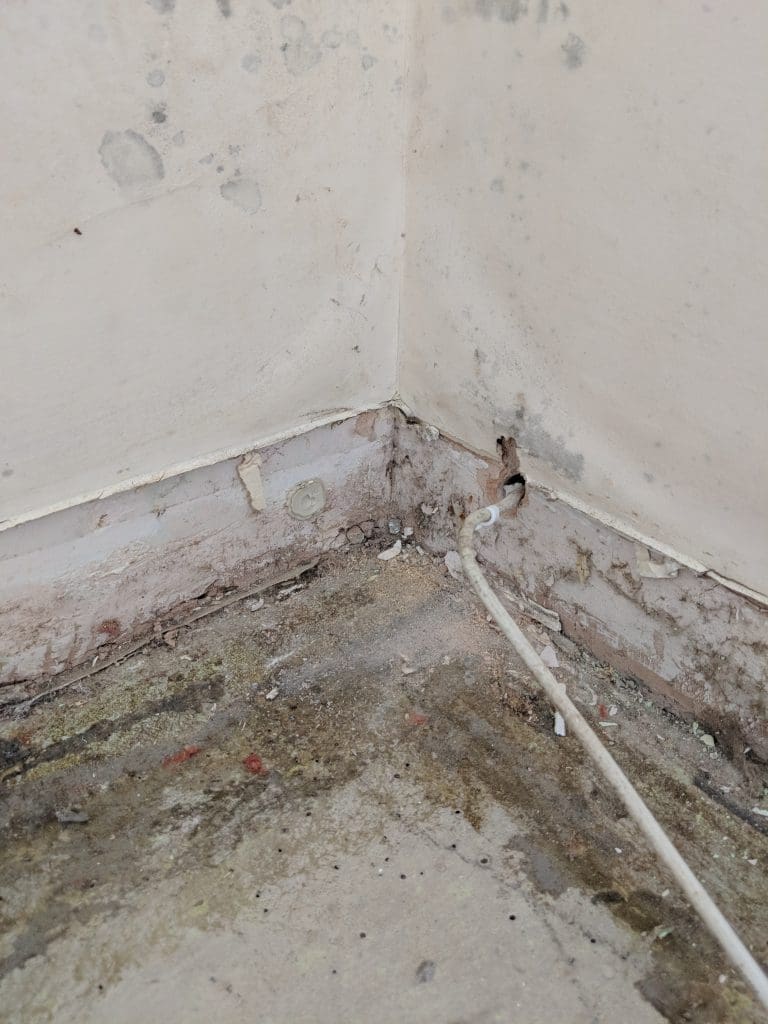
Example: Bridging Is Often Mistaken for Rising Damp
This is bridging, not automatic proof of rising damp.
Bridging occurs when moisture bypasses or compromises the original damp-proof course. This can happen because of high external ground levels, internal plaster in contact with damp masonry, render bridging the wall, debris in a cavity, solid floor junctions or other construction details.
In this type of case, the solution may be to remove the bridge or correct the external defect, rather than inject a new damp-proof course.
This is why a damp survey should look at the building as a whole, not just a moisture meter reading.
When You Should Pay for a Damp and Timber Report
Paying for a professional damp and timber report is usually the better option when you need a diagnosis, written evidence or advice before making a decision.
This is especially useful if you are buying a property, responding to a HomeBuyer Report, dealing with a lender or solicitor request, or deciding whether to accept a quote for damp-proofing or timber treatment.
A paid survey means the inspection and advice are the service. The surveyor is paid to inspect, diagnose and report, not to create a reason to sell major remedial work.
Pay for a report when:
- you are buying a property
- a HomeBuyer Report raised concerns
- a lender or solicitor requested a report
- you have conflicting advice
- expensive treatment has been recommended
- you need written evidence
What a Proper Damp and Timber Report Should Include
A professional report should usually include:
- property details and survey date
- scope of inspection and limitations
- external and internal observations
- moisture readings and interpretation where relevant
- assessment of likely causes
- comments on accessible timber condition
- woodworm, wet rot, dry rot or timber decay observations where relevant
- photographs and clear explanations
- practical recommendations
- estimated cost guidance or a no-obligation quote where requested and appropriate
Dampserve’s Approach
Dampserve provides paid, diagnosis-led damp and timber surveys and reports. Our role is to identify the true cause of the issue and explain what is needed in plain English.
If there is nothing significantly wrong with the property, the report will say so.
If minor works are required, clients can request a separate no-obligation quote. There is no pressure to proceed, and many recommendations may be simple maintenance items that can be handled by a competent tradesperson, homeowner or landlord.
This approach is useful where larger contractors are not interested in smaller jobs, or where clients want practical advice before committing to costly damp-proofing or timber treatment.
Should You Avoid All Free Damp Surveys?
Not necessarily. A free contractor visit may be useful if you already know you want a price for a specific job.
However, if you need a proper diagnosis, a written report, mortgage-related evidence, or advice before buying a property, a paid damp and timber survey is usually the safer option.
The key point is simple:
A free quote tells you what someone may want to sell. A proper damp and timber report should tell you what is actually happening and why.